
Server-Based vs Serverless Architecture: A Clear Comparison
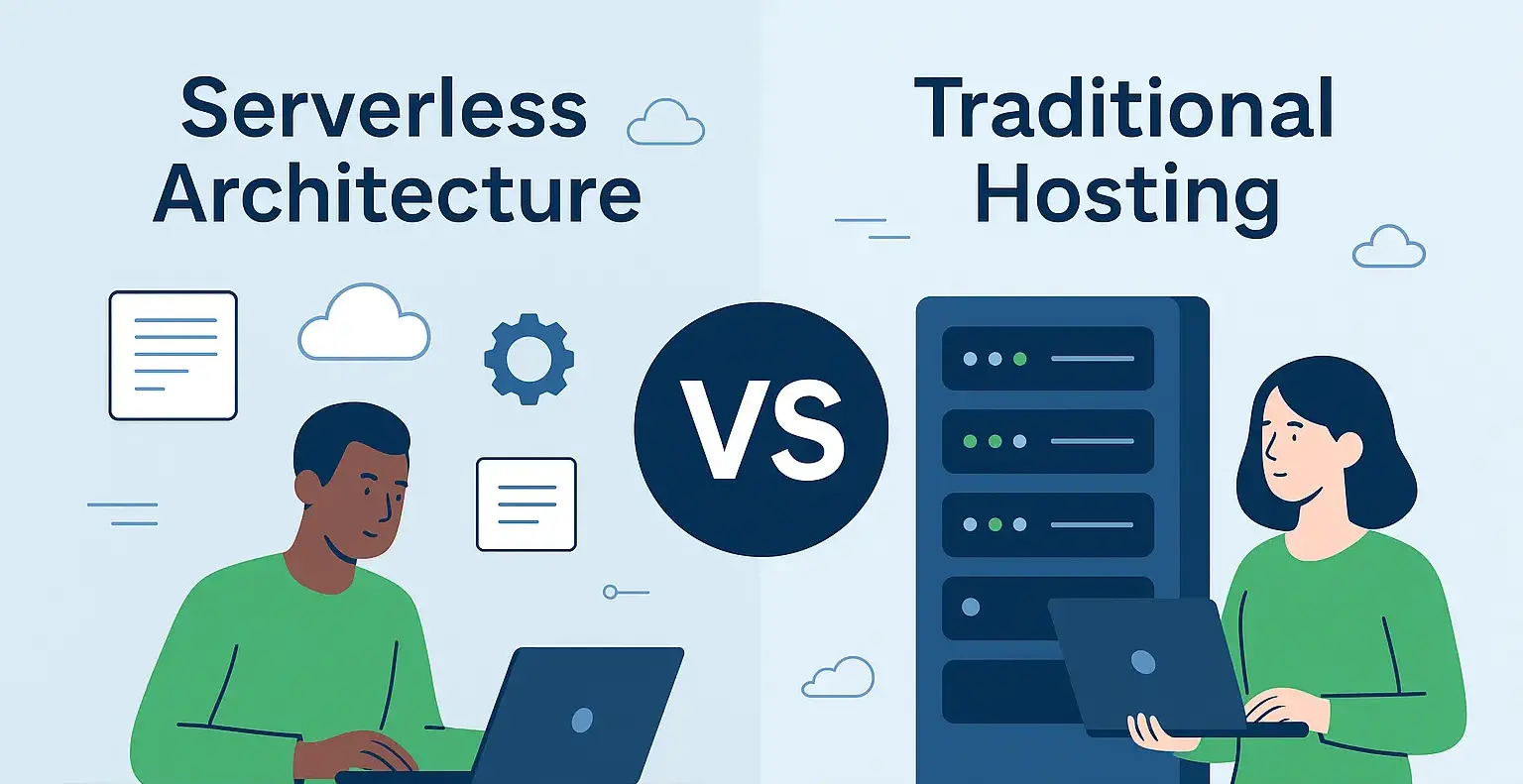
As modern applications grow in complexity and scale, choosing the right architecture becomes critical and important. Nowadays, two common approaches are traditional server-based architecture and serverless architecture. Although both have their uses, serverless offers several advantages that make it highly attractive for modern applications.
Key difference among concepts of Traditional Servers and Serverless Architecture?
In traditional architectures responsibility of managing the server environment still lies with the development team, for example managing operating system and scaling need to be done in manually by the developers.
And when it comes to Serverless, it does not mean “no servers.” It means developers do not need to manage servers. In a serverless model:
The cloud provider manages infrastructure
Code runs in response to events (only when needed)
We only have to pay for execution time (pay-as-you-go)

Traditional Servers use one main server to manage the whole system while serverless break the system into small pieces that run only when required.
Key Benefits of Serverless Over Traditional Servers
For better understanding, I’ll go with my own experience on serverless architectural usage. I’m currently developing a Human Resource Management System (HRMS) for a growing company with my team using AWS . Our system has several features such as,
Employee registration and login
Leave management
Attendance tracking
Automate check-in and out
AI chatbot for HR queries
Role-based access control
Now let’s compare how this system would work using:
Traditional server-based architecture
Serverless architecture
01) If we built the system using Traditional Servers,
In this approach, our team must configure and manage the server and also need to handle scaling manually. The worst thing is, even during non-working hours, the server continues running. So, the company have to pay for the server uptime 24/7.
02) If we built the system using Serverless Architecture,
In here our team do not need to monitor the server. Backend logics run using services like AWS lambda and each function (login, apply leave, approve leave) runs only when triggered. There are no always on servers. Also, during peak traffic (ex- think if 500 employees log in at once to check-in) , the system handles it automatically — so no manual scaling needed. As we only have to pay for what we use this approach is cost effective, for example at midnight, when no one uses the system, cost drops nearly to zero.

Conclusion
To conclude, Serverless architecture has many advantages compared to traditional servers such as less infrastructure management, automatic scaling, lower costs (pay only when used), faster development and deployment, more flexibility. For modern cloud applications, serverless helps teams focus on building features instead of managing servers.
Even though serverless has many advantages, it is not always the best choice. For example, If our application needs to run for many hours continuously or if we need a complete control over the operating system traditional servers can be more suitable. Also, if our system runs 24/7 with steady traffic, paying per execution (serverless) may not be cost-effective. In this case, keeping a server always running can be more practical.
Hence, there is no single solution for every system. The best choice depends on the application’s needs. Today, many organizations use a hybrid approach, combining serverless and traditional servers to get the best performance, cost efficiency, and control.